DE | EN
Series →

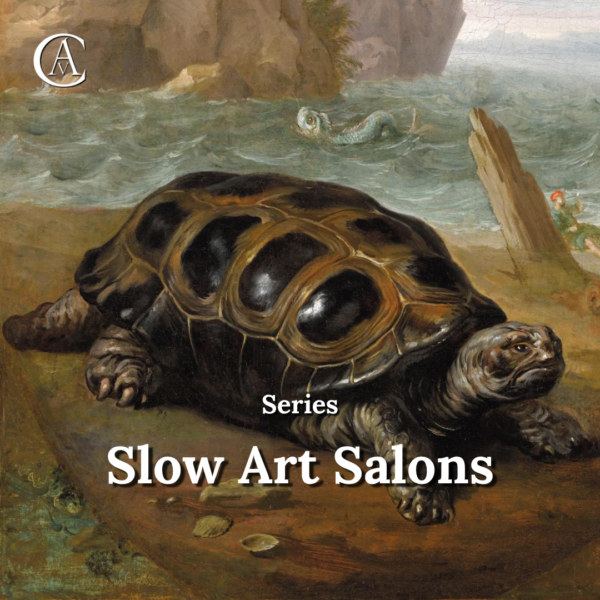
Our Slow Art Salons are a recurring series of carefully curated, individually themed gatherings developed from an idea by art historian Nathalie Krall. Each Salon explores a distinct theme through a thoughtfully selected group of artworks, inviting participants to engage deeply with a focused curatorial narrative. Inspired by the international Slow Art Day, an annual event dedicated to deceleration and sustained, attentive looking at art, our Salons are part of this broader slow-looking movement, bringing its practices into the digital realm. They create a space for close encounters where artworks are both seen and experienced together, inviting new perspectives to emerge through shared attention, thoughtful conversation, and a growing sense of community.

Research in the fields of positive psychology and well-being studies increasingly suggests that sustained encounters with works of art can contribute to eudaimonic well-being, a state rooted in meaning, reflection, emotional awareness, resilience, and a deeper sense of connection with ourselves, with others, and with the world around us. The Slow Art Salons create the conditions for these experiences through sustained attention, curiosity, and conversation.

At the center of each Salon is a close, intimate encounter with a small selection of curated works, and the discovery of details, meanings, and perspectives that only emerge over time and through shared attention.

Each Slow Art Salon begins with a quiet stretch of focused looking at a few selected works. Then we open things up into conversation—open, informal, sometimes surprising—where impressions, questions, and different readings can surface. The group shapes the flow of the discussion, which is what makes each Salon feel alive and different every time. The formats vary in scope and context, but they stay committed to one core idea: Slowing down how we look, and paying attention with care.

What all Salons share is a space on equal footing, where people can think out loud, listen closely, and make meaning together. The belief underneath is that the art world of the future is shaped through shared attention, honest conversation, and collective thinking that keeps unfolding long after each session ends.


What to expect …

We begin by looking. Carefully, slowly, without urgency. What is visible? What stands out? What feels unresolved? Thoughts and emotions come, linger, and pass.

From there, we cross into the realm of words. Participants describe what they see, translating perception into language. This is where interpretation begins—growing deeper and more layered with every thought we exchange.

Then additional context enters the conversation. Layers of meaning open up, each one extending the conversation—art historical perspectives, titles, scale, biography, and historical context.

  • How does a title shift the reading of an image?
  • What happens when we imagine its scale?
  • How do biographical details complicate what first seemed clear?
  • What questions does historical context raise?

All thoughts are welcome. All ideas are appreciated.

We look at up to three artworks together. For each work, we spend about five minutes in silent observation—simply looking, perceiving, breathing. Afterwards, we open the digital space for shared exchange: What thoughts emerged? Which ones passed through? And which ones stayed?

The curator of the session brings together a selection of artworks that we encounter collectively. No expert talks. No presentations. No prior knowledge required. Our Slow Art Salon is grounded in the moment of looking, in the time we give ourselves, and in the curiosity that remains.

All you need is a stable internet connection, a screen, and a willingness to enter this small, exciting experiment.Layers of meaning open up, each one extending the conversation—art historical perspectives, titles, scale, biography, and historical context.  (NK)

Inspired by

Additional Information & Resources

Bown, Claire. “How to Keep Practicing Slow Looking After Slow Art Day.” 2025. https://thinkingmuseum.com/2025/04/08/how-to-keep-practicing-slow-looking-after-slow-art-day/ (accessed 8 April 2025).

Kaplan, Isaac. “How Long Do People Spend Looking at Art in Museums?” Artsy. https://www.artsy.net/article/artsy-editorial-long-people-spend-art-museums (accessed 1 July 2026).

Slow Art Day. “Slow Art Day Annual Report 2025. 15th Anniversary Report.” https://www.slowartday.com/about/ (accessed 1 July 2026).

Smith, Lisa F., Jeffrey K Smith, Pablo P. L. Tinio. “
Time Spent Viewing Art and Reading Labels.” ResearchGate. https://www.researchgate.net/publication/296475094_Time_Spent_Viewing_Art_and_Reading_Labels (accessed 1 July 2026).

Trupp, MacKenzie D., Claire Howlin, Anna Fekete, Julian Kutsche, Joerg Fingerhut, and Matthew Pelowski. “The Impact of Viewing Art on Well-being—A Systematic Review of the Evidence Base and Suggested Mechanisms.”” The Journal of Positive Psychology (2025). https://doi.org/10.1080/17439760.2025.2481041.

Universität Wien. “Adding Art to Our Lives Boosts Well-being.” https://www.univie.ac.at/en/news/detail/adding-art-to-our-lives-boosts-well-being (accessed 1 July 2026).

Past Events

11 April 2026
Slow Art Day

ArtVenture Club’s first art experience to discover the art of slowing down
curated by art historian Nathalie Krall

4 July 2026

Curated by Art Historian Nathalie Krall

CONTACT PERSON

Liaison
Network & The Art World of the Future